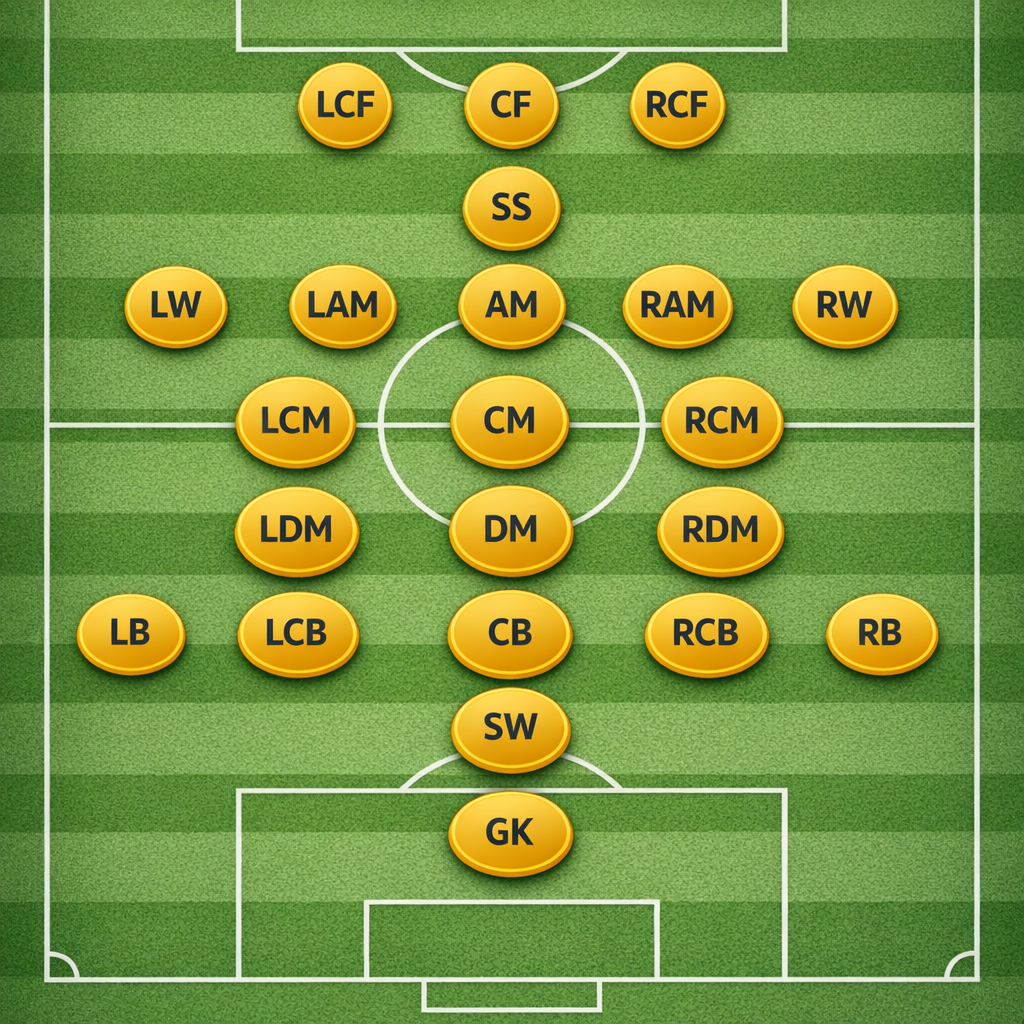
The KoraStats platform uses a standardized set of position IDs and codes to classify the tactical role of each player on the field.
These position identifiers are used throughout the system for:
match lineups
event attribution
tactical analysis
statistical aggregation
positional performance metrics
API integrations
Each position is represented by a unique Position ID, a short code, and a full descriptive name.
For API integrations, use the Position ID as the unique identifier for a player position. Position codes provide a human-readable representation of the corresponding tactical role.
The following table contains the complete KoraStats player position taxonomy used for API integrations.
Position ID
Code
Position
1
GK
Goalkeeper
2
SW
Sweeper
3
CB
Center Back
4
RB
Right Back
5
LB
Left Back
6
DM
Defensive Midfielder
7
CM
Central Midfielder
8
AM
Attacking Midfielder
9
RW
Right Winger
10
LW
Left Winger
11
SS
Second Striker
12
CF
Center Forward
13
LCB
Left Center Back
14
RCB
Right Center Back
15
RDM
Right Defensive Midfielder
16
LDM
Left Defensive Midfielder
17
LM
Left Midfielder
18
RM
Right Midfielder
19
RAM
Right Attacking Midfielder
20
LAM
Left Attacking Midfielder
21
RCF
Right Center Forward
22
LCF
Left Center Forward
23
RWB
Right Wing Back
24
LWB
Left Wing Back
When an API field expects a position identifier, integrations should send or interpret the numeric Position ID, rather than relying solely on the position code.
Center Back (CB)
Central defenders positioned in front of the goalkeeper who focus on marking attackers, intercepting passes, and blocking shots.Sweeper (SW)
A deeper defensive role positioned behind the defensive line, responsible for covering defensive gaps.Full Backs (RB / LB)
Defenders positioned on the right and left sides of the defensive line who contribute both defensively and in wide attacking support.Wing Backs (RWB / LWB)
Wide defensive players who operate higher up the pitch than traditional full backs and contribute extensively to both defensive and attacking phases.
Defensive Midfielder (DM)
Plays in front of the defensive line and focuses on breaking up opposition attacks and protecting the defense.Central Midfielder (CM)
Operates in the central area of the pitch, linking defensive and attacking phases.Attacking Midfielder (AM)
Plays closer to the opponent’s goal and focuses on creating scoring opportunities.Wide Midfielders (LM / RM)
Provide width in midfield, supporting both attacking plays and defensive coverage.
Center Forward (CF)
The main attacking player positioned centrally and primarily responsible for scoring goals.Second Striker (SS)
A supporting striker who plays behind the main forward and contributes to both goal creation and scoring.Wingers (RW / LW)
Wide attacking players positioned on the flanks who provide width and deliver crosses or attacking runs.Wide Forwards (RCF / LCF)
Advanced attackers positioned slightly off-center, often used in multi-forward tactical systems.
The standardized position taxonomy enables consistent analysis of:
player performance by role
positional heatmaps
tactical formations
lineup structures
cross-system position mapping
API integrations
Each position has a stable Position ID and position code, allowing external systems to map player roles consistently when integrating with KoraStats.These identifiers serve as the foundation for tactical analysis, statistical comparisons, and position mapping within the KoraStats platform and its APIs.